NGO Warfare against Israel Inbox Uri Zehavi from Guerre & Shalom Unsubscribe 11:40 AM (32 minutes ago) to me Forwarded this email? Subscribe here for more NGO Warfare against Israel What happens when you cite terrorists Uriel Zehavi · אוריאל זהבי Jun 30 ∙ Preview READ IN APP Uri Zehavi’s unique contribution to the Israel libel debate is his understanding of citation —or should I say miscitation. It is taken as axiomatic that cross-referencing is a good thing; that it ensures academic seriousness and a rigorous commitment to truth. But how stable is this formula. What if the original claim quoted by all subsequent authors is a falsehood? And what if those falsehoods aren’t innocent errors? What if they are foreseeable, even inevitable? Well that’s precisely the falsehood merry-go-round that pertains in the “human rights community” especially as it relates to Israel. The BBC quotes the ICC who quotes

|
11:40 AM (32 minutes ago)
|
|
||
|
||||


Uri Zehavi’s unique contribution to the Israel libel debate is his understanding of citation —or should I say miscitation. It is taken as axiomatic that cross-referencing is a good thing; that it ensures academic seriousness and a rigorous commitment to truth. But how stable is this formula. What if the original claim quoted by all subsequent authors is a falsehood? And what if those falsehoods aren’t innocent errors? What if they are foreseeable, even inevitable? Well that’s precisely the falsehood merry-go-round that pertains in the “human rights community” especially as it relates to Israel. The BBC quotes the ICC who quotes the UN special rapporteur in turn. Albanese then cites a “respected NGO” who cites a human rights lawyer who references a “Palestinian non-violence campaigner” who works for Hamas or PFLP in the evening. The laundering of citations makes the claim look unimpeachable, when in fact it is built on a house of cards. It’s a lie spread by Anti-Western terrorists. This cycle of falsehood is repeated unceasingly and unapologetically, not because the actors are short of a brain cell, but rather because they form part of a sect: Uri’s aptly named “Campus Catechism”. Rooted Truth is possibly the clearest exposition of this theorem ever penned. It exposes the entire “human rights” lie and worse than that, it undermines the entire foundation of the university citation system. Read it. Spread it. CITE IT! - Daniel Clarke-Serret (Editor) Other titles from the Guerre & Shalom Publishing House:
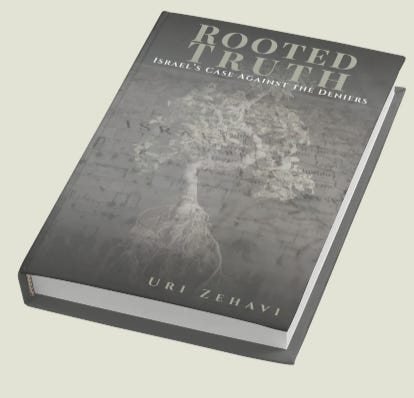
Rooted Truth: Israel’s Case Against the Deniersby Uri ZehaviPreface & Introduction: The Return of the Lie // Chapter 1: Setting the Record Straight // Chapter 2: From Balfour to Independence // Chapter 3: By Right, Not Permission // Chapter 4: Apartheid as Propaganda // Chapter 5: Colonialism and the Great Erasure // Chapter 6: The Genocide Libel // Chapter 7: The UN Assembly Line // Chapter 8: Campus Catechism Chapter 9: NGO LawfareSummer 2014. Fighting in Gaza is underway. A single figure ricochets around the world: “69 percent of those killed were civilians.” A United Nations brief cites more than 2,100 Palestinian fatalities and repeats the claim that nearly three quarters were noncombatants. Major outlets print it as settled fact. The source is the Gaza Health Ministry, run by Hamas, a combatant that lists its own gunmen as “civilians” and counts no distinction between a rifleman and a bystander. In one news cycle, Israel’s war of self-defense is reframed as a massacre. Courts have not sat. Evidence is still being gathered. The verdict in global opinion is already signed: war crimes. You know the pattern. Rockets slam into Israeli towns. Israel strikes back at launch crews and command posts. Within hours, a chorus of NGOs and UN offices floods the field with “assessments,” casualty spreadsheets, emergency resolutions, legal condemnations. The battlefield is only half the fight. The improvised courtroom—pressrooms, human-rights panels, donor conferences—becomes the other front. The loudest numbers came from a Hamas ministry and were amplified by groups that rarely ask who died doing what. When later checks by Israelis and independent analysts identified large shares of combatants among the dead—men of fighting age, named militants, operatives confirmed by their own factions—the headlines did not correct. The myth of “mostly civilians” had set like concrete. The truth—that Hamas hid behind families, staged attacks in alleys and schools, and laundered the body count—trailed far behind. Over decades, non-governmental organizations claiming to speak for “human rights” have turned international law into a weapon aimed at the world’s only Jewish state. Reports are fired like rockets. Casualty tables are massaged to indict Israel in the court of public opinion. Legal trigger words—war crimes, apartheid, genocide—are deployed with strategic precision, stripped of context and intent. Meanwhile Hamas, Hezbollah, and their state patrons sit in the gallery, delighted to see a democracy dragged before tribunals while the authors of the carnage dodge the dock. The method is simple. Start with a narrative minted in a seminar—Israel as “settler-colonial,” “apartheid,” “genocidal.” Feed it to a friendly clinic, dress it in footnotes, publish it as a study. Pass it to an NGO with a letterhead. Hold a press conference. Secure a quote from a UN special rapporteur already on record as an activist. By the time a rocket is recovered from a schoolyard or a dead fighter is named by his own brigade, the story has moved on. The accusation has done its work. This is the machinery of denial at scale. It does not rely on tanks. It runs on grant cycles, press lists, and the reflexive deference many journalists and diplomats still grant anything stamped “human rights.” It is purposeful. It is well funded. It is utterly cynical. The same slogans from campus—“apartheid,” “genocide,” “colonizer”—now appear in glossy dossiers and “urgent appeals.” The passage from quad to quorum is not accidental. NGOs translate chants into charges. They turn activist framing into “findings.” They give the academy’s dogma a patina of neutrality, then wheel it into Geneva and The Hague. Origins and FundingThe NGO barrage did not materialize by itself. It was built, financed, and franchised. In the 1990s—Oslo’s glow and the global boom of “civil society”—a dense archipelago of organizations appeared to monitor, educate, and litigate around Israel... Keep reading with a 7-day free trialSubscribe to Guerre and Shalom to keep reading this post and get 7 days of free access to the full post archives. A subscription gets you:
© 2026 Daniel Clarke-Serret
|






|
10:25 AM (0 minutes ago) |
|||
|
|||


|
9:57 PM (1 minute ago) |
|||
|
|||


Comments
Post a Comment